
Nonlinear Growth in a Disrupted World: What Globally Active CEOs, CFOs, and Investors Are Actually Thinking Right Now
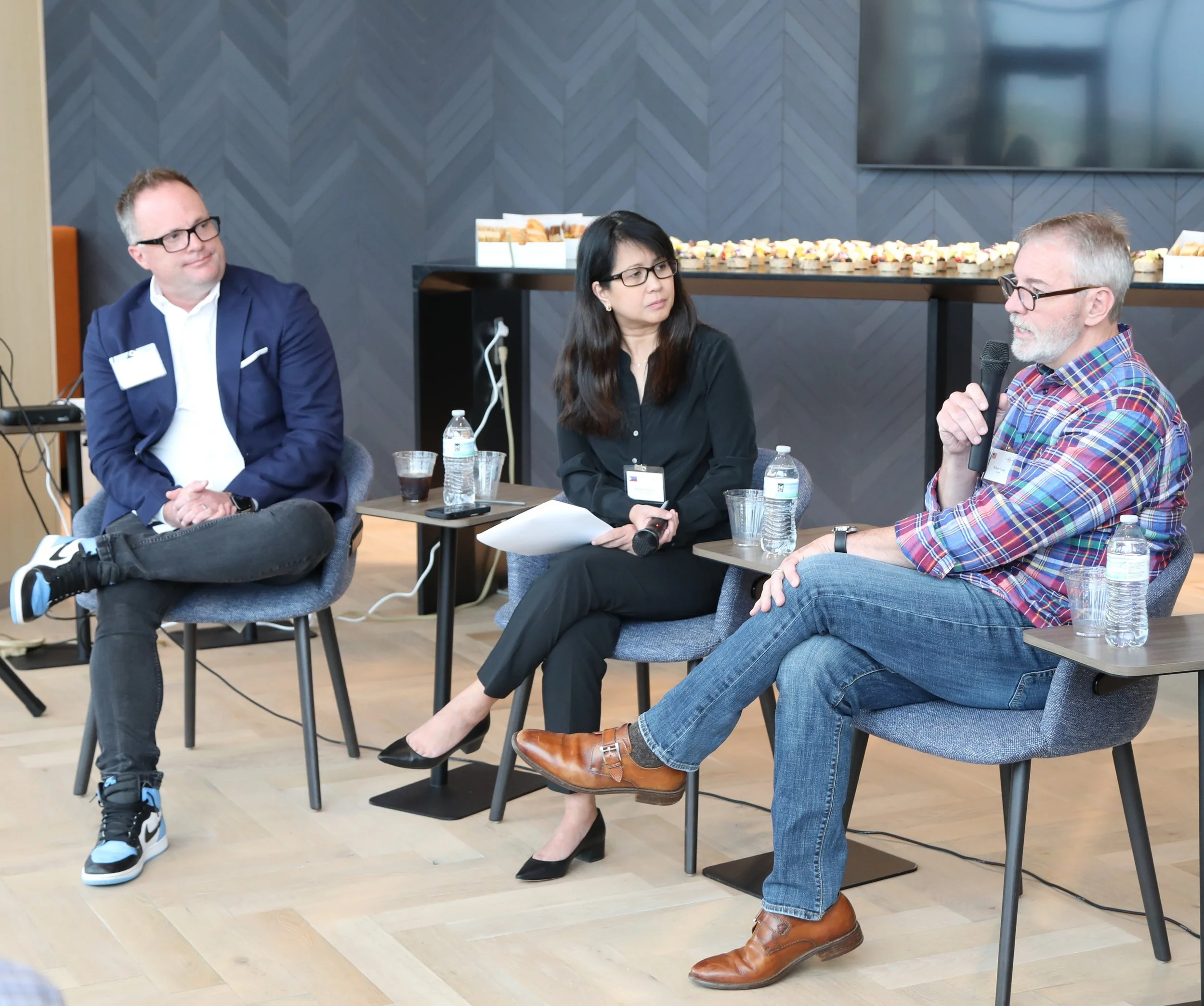
IBCircle CEOs and CFOs Global Roundup at Wipfli, Denver, 06/03/2026
On June 3, IBCircle brought together 60 internationally active business leaders at one of Denver's most spectacular locations to tackle the question every executive is asking but few are answering honestly: how do you make sound strategic decisions when the rules keep changing faster than your planning cycle?
The short answer: you stop pretending the old playbook still works, you get brutally honest about where your organization actually is with AI, and you start thinking in decades rather than quarters.
That, at least, was the consensus that emerged from the IBCircle CEOs & CFOs Global Roundup on June 3, 2026 — hosted and sponsored by Wipfli at their stunning River North rooftop in Denver. The conversation was moderated by Magnolia Movido, Partner and Head of International Tax at Wipfli, and featured two of the most candid and practically grounded voices IBCircle has ever put in front of a room.
Matt Frary — serial entrepreneur, five exits in digital marketing, founder of Chief of Chaos and XP Flow, and advisor to Iterate.ai — stepped in at a few hours' notice for Jon Nordmark and delivered what several attendees described as the most uncomfortably honest business conversation they had been in all year. Richard Lackey — Chairman of the World Food Bank, CIO of Trade Oracle Group, and Founding Board Member of both the Institute for Applied AI and Robotics and OpenAg.AI — brought a perspective that most Colorado business leaders had never encountered: what AI at genuine scale, in the world's most difficult markets, actually looks like.
"Data is the new crude oil. And agentic AI — the extraction layer — is what turns that crude oil into something valuable. Most companies are sitting on a reservoir they have never drilled."
— Matt Frary, Chief of Chaos
The Re-Globalization Question
The evening opened with a question that most business media is getting wrong: is globalization over?
Matt Frary's answer reoriented the entire conversation. The question, he argued, is not about the flow of atoms — goods, tariffs, physical supply chains. It is about the flow of bits. Data sovereignty regulations in India, the UAE, the UK, and the EU are creating a new kind of border that has nothing to do with tariffs. Countries and companies that understand this are racing to control not just physical supply chains but the data infrastructure that will determine competitive advantage for the next decade.
Richard Lackey built on this with a structural observation from international capital markets: the just-in-time model has been exposed as fragile. His hedge fund illustration made the point precisely — a fund with 150 investors but five representing 90% of assets was valued at 1.5 times earnings. A fund with 3,000 distributed investors was valued at eight to ten times. Concentration is the risk. Distribution is the moat. The same logic applies to supply chains, customer bases, and geographic footprints.
"We are not de-globalizing. We are re-globalizing. It is being repackaged. You have to understand the US and China set the terms and the standards. You need to understand how to adapt and play by those grounds."
— Bob Mulverhill, OXT Technologies / IBC Ventures
The AI Conversation Nobody Wants to Have
The most practically useful — and most uncomfortable — segment of the evening was the AI discussion. Matt Frary's diagnosis was direct: the most expensive AI mistake almost every organization in the room was making is deploying access without a plan.
Companies are buying thousands of enterprise AI licenses, distributing access to employees, and watching credits disappear on image generation and email rewrites — with no defined success metrics, no change management, and no plan for how any of it connects to business value. Worse: in doing so, organizations are sending sensitive data — financial records, customer information, internal communications — into public large language models that were never designed to be private.
His challenge to the room produced the most memorable moment of the evening. Three questions, asked in sequence: How many of you are experimenting with AI? Most hands. How many have built an AI agent? Fewer hands. How many have built one agent end-to-end, solved one specific problem, proven the ROI, and moved to the next? Almost no hands.
That gap — from experimentation to execution to value — is where most organisations are stuck. And closing it, both speakers agreed, is the most important AI work available right now.
"Find the one process in your business that is least efficient. Build one agent. Define success before you start. Measure it. When you can prove the ROI on that one thing, you have the template for everything that follows."
— Matt Frary, Chief of Chaos
Where the Real AI Investment Opportunity Is
Both speakers converged independently on the same insight: the investment thesis that will create durable value is not in the frontier models — OpenAI, Anthropic, Google — whose valuations are already stretched. It is one layer down, in the application layer.
Richard Lackey's OpenAg.AI project is the most vivid illustration. A non-frontier, multi-agentic model built on 117,000 USAID research documents, running on-device without internet connectivity, giving a smallholder farmer in western Uganda real-time agronomic advice calibrated to their specific resources and region. The project has saved over one billion dollars in crop loss and lifts over a million people out of poverty annually. Not through advanced frontier technology — through applied AI solving a specific, bounded, high-consequence problem.
The principle generalises to every industry: applied AI working on real problems in specific contexts is where the sustainable returns are being built.
"The value is not in the frontier models. It is in the applications — the companies that take those capabilities and deploy them against specific, high-consequence problems. That is where the durable returns are."
— Matt Frary, Chief of Chaos
Community Is the Competitive Advantage AI Cannot Touch
One of the evening's most unexpected insights came from an unlikely data point: 70,000 people attended a Morgan Wallen concert in Denver across two consecutive nights. The hunger for in-person, shared, communal experience is not declining — it is accelerating.
Richard Lackey confirmed the principle from a completely different angle: Longer Tables, a Colorado organisation that gathers thousands of people in Littleton's streets and seats them next to strangers for dinner, builds community by removing the transactional frame entirely. For business leaders, the implication is direct. The organisations that invest in genuine human connection — with customers, employees, and communities — are building something that AI cannot replicate, automate, or commoditize. This is not a soft observation. It is a structural competitive argument.
"The value in my company is not the revenue from selling TV ads. The value is in community. Community is what you cannot replicate with AI. That is where I invest."
— Richard Lackey, Chairman, World Food Bank
Why Colorado Is Better Positioned Than Silicon Valley
Richard Lackey made the most quotable statement of the evening without qualification: if he were choosing where to build new technology today, he would not be moving to New York or San Francisco. He would be buying an off-road bicycle and moving to Colorado.
The combination of entrepreneurial culture, lower cost base, regulatory clarity on AI (including the significant legislative win Matt Frary described — a business-friendly AI bill signed by Governor Polis within weeks of the event), quality of life, and the concentration of globally experienced talent makes Colorado genuinely exceptional right now. The Bavarian Guild confirmed the signal from overseas: European and German companies are actively looking at Colorado as a preferred US entry market. The FDI interest is real, it is growing, and Colorado is positioned to capture it.
"If I was looking for the place to build new technology today, I would not be moving to New York. I would not be moving to San Francisco. I would be buying a nice off-road bicycle and moving to Colorado."
— Richard Lackey, Chairman, World Food Bank
Five Things to Do Before the End of Q3 2026
1. Run a data audit. Map where your company's data lives — every system, every silo. Identify your three most valuable data assets and build a 30-day plan to make them accessible to AI tools.
2. Pick one process, build one agent. Find the least-efficient process in your business. Assign one person. Set a clear success metric before starting. Run for 30 days. Measure. The proof point from that first agent will make the case for everything that follows.
3. Conduct a private AI audit. List every AI tool in use. For each: is data leaving your environment? Create a three-tier policy — public AI acceptable · review needed · private AI required — and implement it within 60 days. Don't wait for a breach.
4. Have the Colorado positioning conversation. If your business is making decisions about geographic expansion, talent recruitment, or technology infrastructure in the next 12 months, put Colorado explicitly on the board agenda.
5. Make one community investment. Identify one initiative in the next 90 days that invests in genuine human connection — not a marketing campaign, but something that brings people together around shared purpose. Something no AI can replicate.
The full IBCircle Think Tank Report — Nonlinear Growth in a Disrupted World — is available now free of charge compliments of Wipfli at: Download June 3 Event Report.
IBCircle's next Think Tank events are August 25 and October 22, 2026.
About IBCircle
International Business Circle (IBCircle) is a Colorado-based Think Tank and independent business network for CEOs, founders, executives, and investors in internationally active businesses. Founded in 2004. Members from 30+ countries. Twice named Business Networking Organisation of the Year — Global Innovation and Excellence Awards 2025 & 2026.